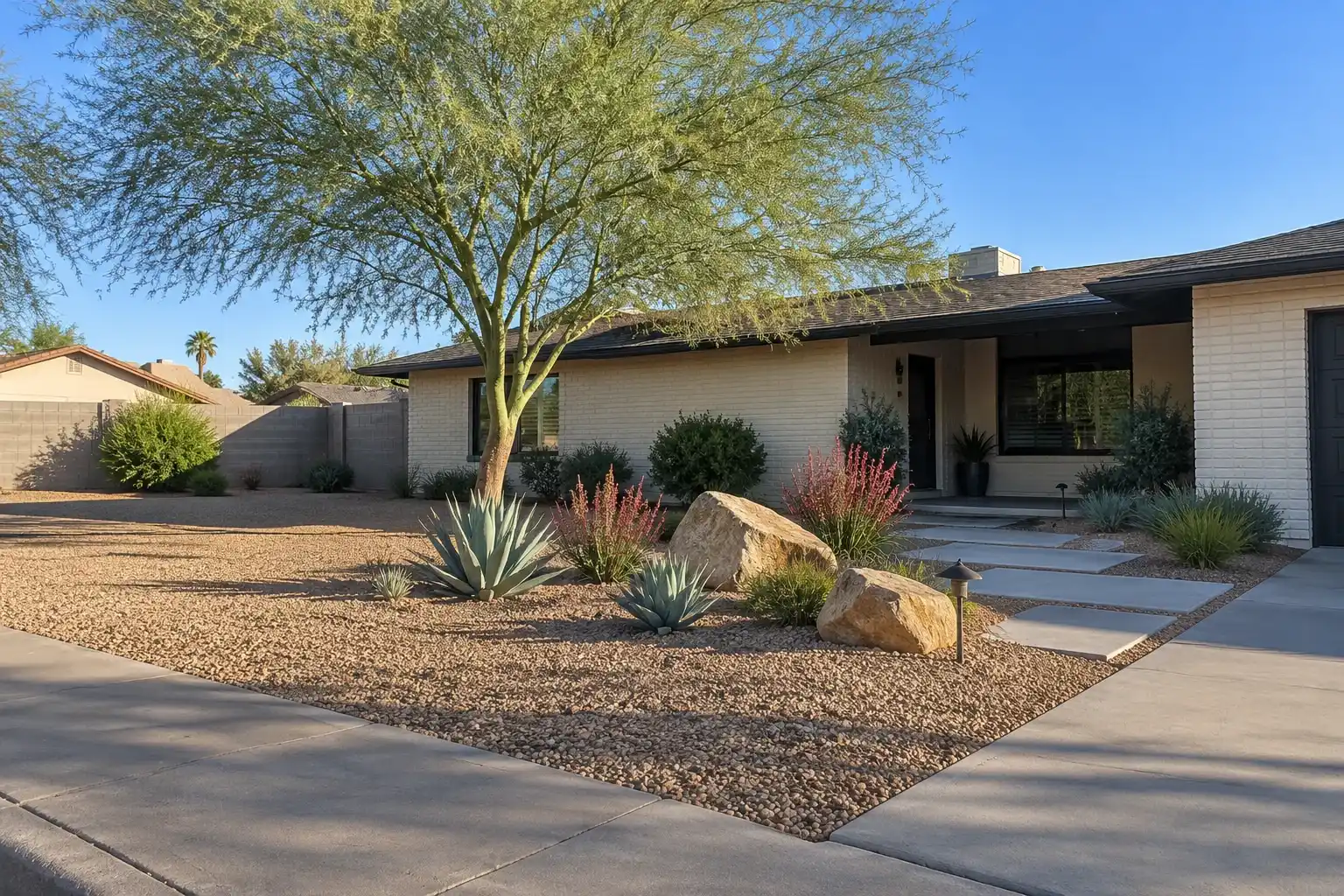
Desert front yard with a palo verde tree, agaves, boulders and gravel beds in front of a single-story ranch house

Landscaping · Chandler, Arizona

Landscaping in Chandler, AZ

Last updated

You want a yard that looks good in July and does not run up the water bill. Tell us what you picture, from new turf to a full redesign, and someone from our team will call you back to plan it.

See published price ranges

Get a call back

Name, phone, ZIP and the job. About a minute.

Thank you. You will be called back soon.

Landscaping in Chandler means planning for zone 9b cold snaps, caliche under the topsoil, and a city water schedule that rewards drip over spray. Design, installation and repair all start from the published cost ranges, shown before anyone walks the property.

024 services

Which landscaping services are available in Chandler?

5 services cover the common Chandler yard projects. Each is scoped from published national ranges before anyone walks the property, and the final number comes after a look at the lot, the soil and the grade.

Design comes first when a yard is bare or the whole yard is changing. Repair and turf replacement can start on their own, and both are worth doing before summer rather than in it.

  1. 01 / 16

    What does landscaping cover in Chandler?

    Landscaping covers everything outside the walls of the house: the shape of the lot, the plants, the irrigation that keeps them alive, the hard surfaces, and the grade that moves water away from the walls. On a Chandler lot that usually means desert adapted trees and shrubs, a drip system on a controller, and one smaller lawn or turf area where people actually walk.

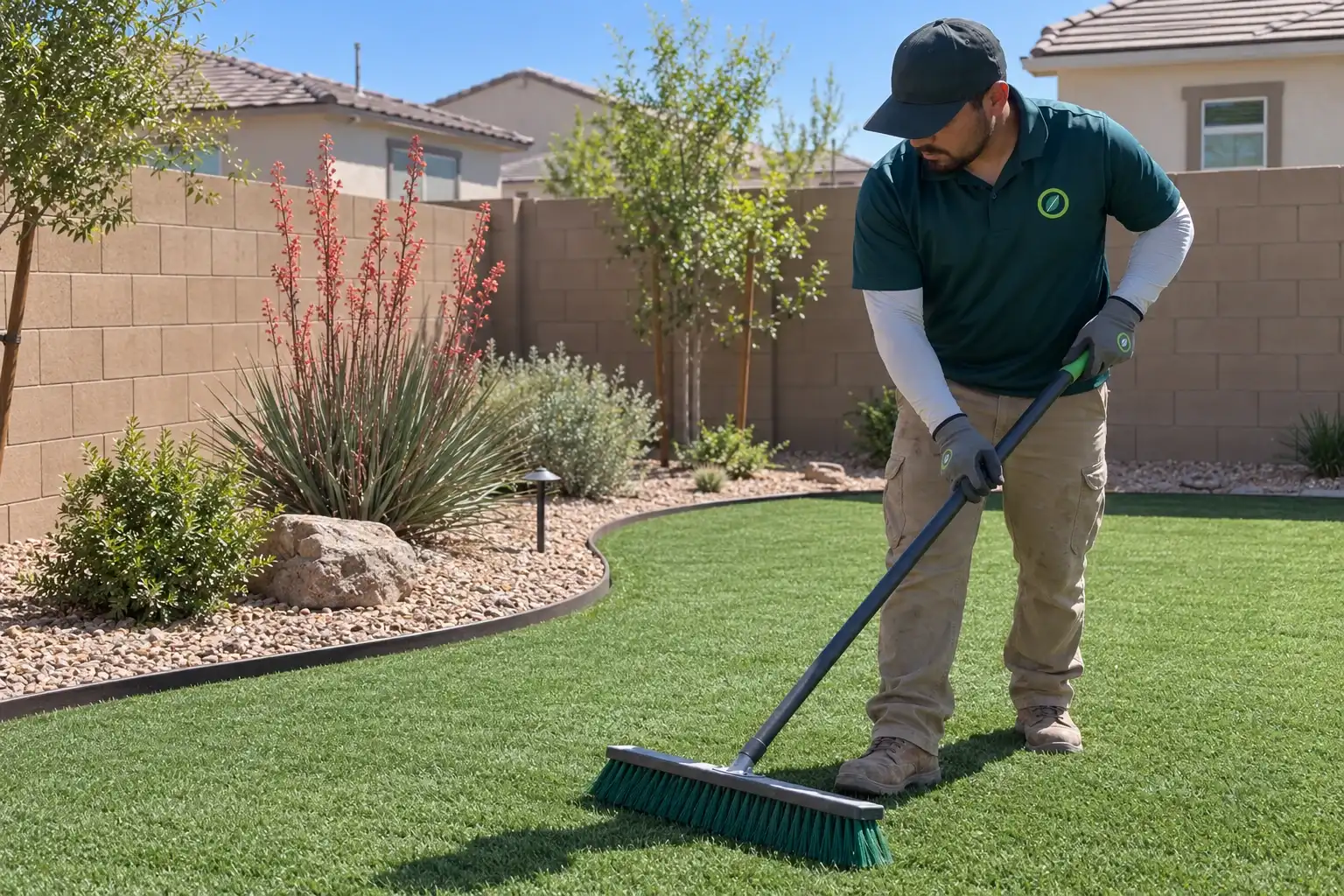
    The work splits into 5 jobs on most properties: design, planting, irrigation, artificial turf, and pavers or patio work. Some homeowners need all 5 on a bare lot behind a new house. Others need one, such as a run of broken sprinkler heads swapped before the heat arrives.

    Maintenance sits outside that list. This is the build, not the weekly mow. A yard that holds its shape with little upkeep gets that from the plan: right plant, right place, right emitter, and hardscape where grass would otherwise struggle.
  2. 02 / 16

    What usually needs HOA approval before a yard change?

    HOA approval depends on your subdivision's rules, not on a city permit. Chandler has more than 112,000 housing units (City of Chandler (opens in a new tab)), and many of them sit inside subdivisions with an architectural review step, so the first call is often to the management company rather than to a contractor.

    Boards tend to ask for 4 things: a drawing that shows where turf, plants and hardscape land, a plant list with mature sizes, the wall or fence height, and where water drains. Turf color and pile height can come up, because a bright green strip beside desert planting reads wrong to a review committee.

    Submit before you buy material. Review runs on the board's meeting calendar, and a change after approval usually means resubmitting. Keep the approved drawing on site. If a neighbor questions the work later, that approved page settles it faster than any phone call.

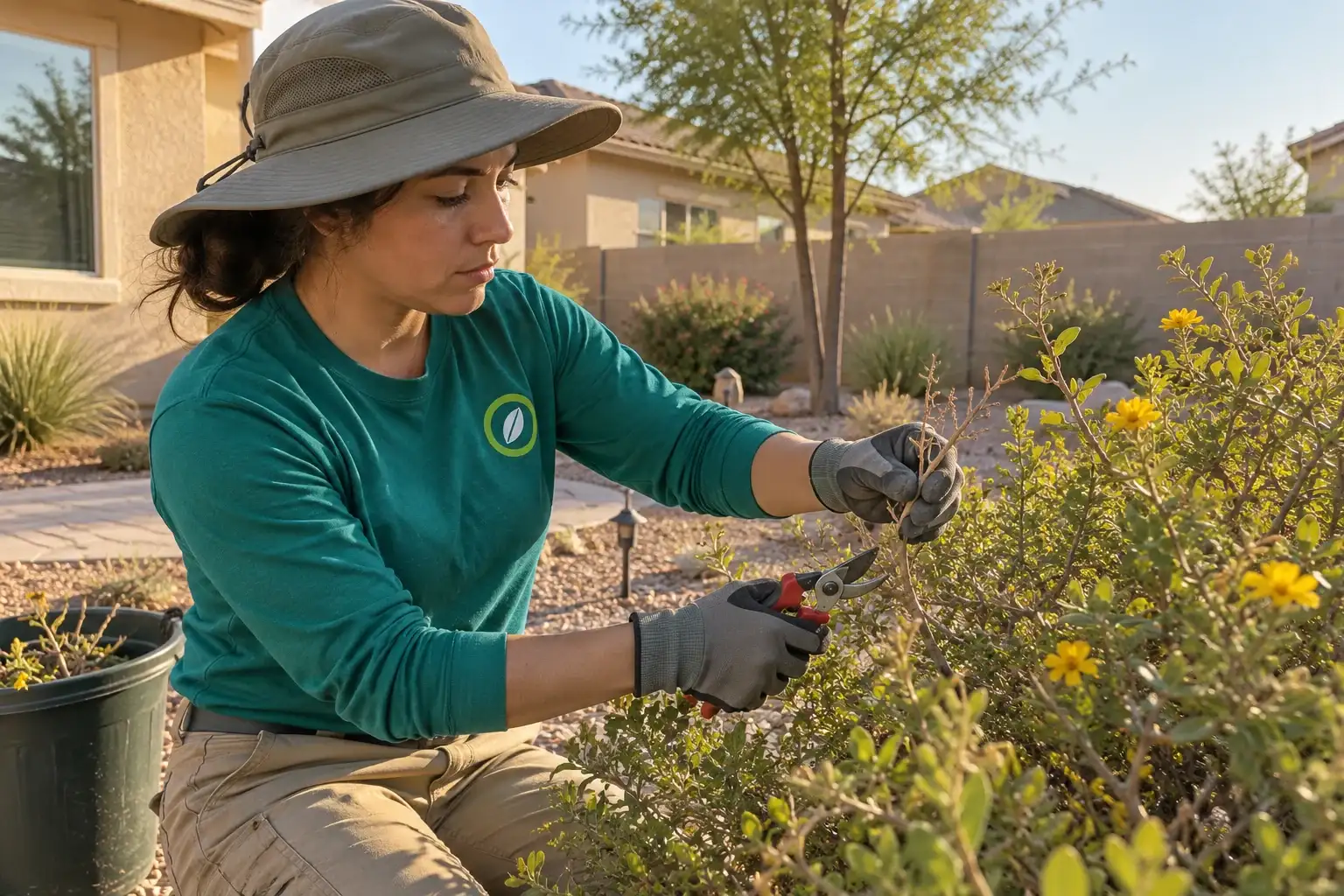
    Landscaper in a sun hat trimming a flowering desert shrub with hand pruners
  3. 03 / 16

    Is it landscape or landscaping?

    Landscape is the noun and landscaping is the work. Your landscape is the yard itself: the plants, the turf, the walls, the grade. Landscaping is what happens to it, and it is also the name of the trade.

    So you hire a landscaper to do landscaping on your landscape. A finished yard is landscaped. The word landscape also covers the drawing stage, which is why a designer hands you a landscape plan and not a landscaping plan.

    The difference matters when you search. Landscape design pulls up designers. Landscaping pulls up install and maintenance crews. Landscape contractor pulls up the companies that build walls and move dirt. A yard that gets built, not just drawn, falls under the second and third.

  4. 04 / 16

    What does landscape design and installation include here?

    Design and installation covers the drawing, the plant selection, the irrigation layout and the build. On a Chandler lot the sequence starts with the soil and the grade, because both decide what survives a summer.

    The design sets 5 things: where turf goes, which plants go where and how big they get, how the drip lines run and where the valves sit, how pavers meet the planting beds, and which way water leaves the yard. Mature size matters more than the size at the nursery. A tree planted 4 feet from a wall can become a problem within a few years.

    Installation follows the drawing: break the soil, set the grade, run irrigation, place plants, lay turf or pavers, then mulch and test every zone. New landscape installation runs $3,000 to $16,000 nationally, per a national cost guide, 2026, before the price of walls or a patio.

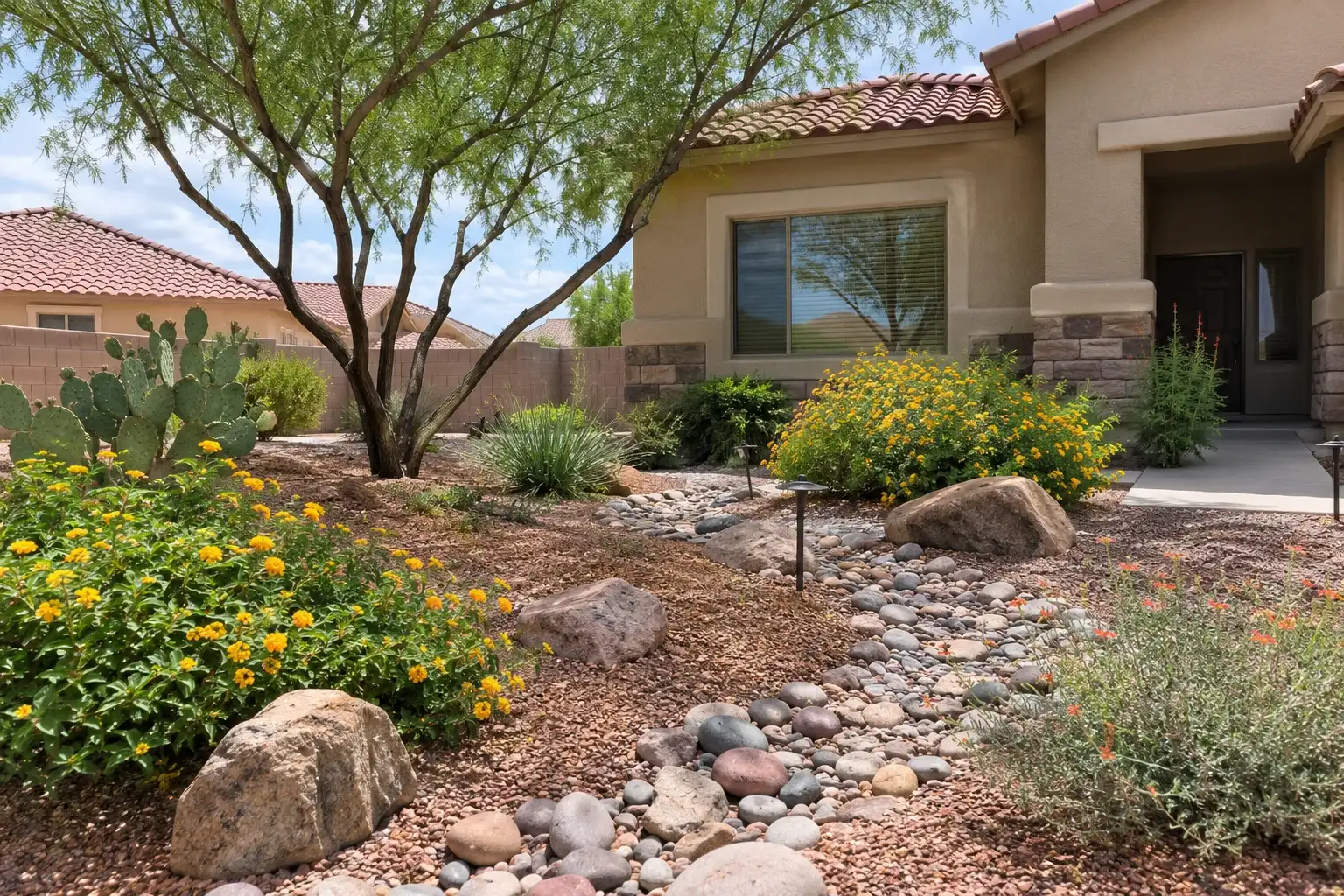
    Dry creek bed of river rock winding through decomposed granite, boulders, prickly pear and yellow lantana
  5. 05 / 16

    What does artificial turf cost in Chandler?

    Artificial turf averages $5,783 nationally, with most projects between $3,244 and $8,714, and materials at $2 to $8 per square foot (national cost guide, 2026, 2,284 projects). A Chandler install can land in that band unless the base has to be built up or drainage added.

    Square footage drives the total more than the turf brand. A narrow pet run and a full backyard use the same crew for very different amounts of base, haul off and seam work. Base depth, compaction and a weed barrier are where cheap jobs can cut corners, and heat can show where within a summer or 2.

    Turf is also not eligible for the city grass removal rebate, so a yard plan that mixes turf and gravel cannot claim the rebate on the turf area.

    Published ranges, not a quote.

  6. 06 / 16

    Do pavers work in a Chandler yard?

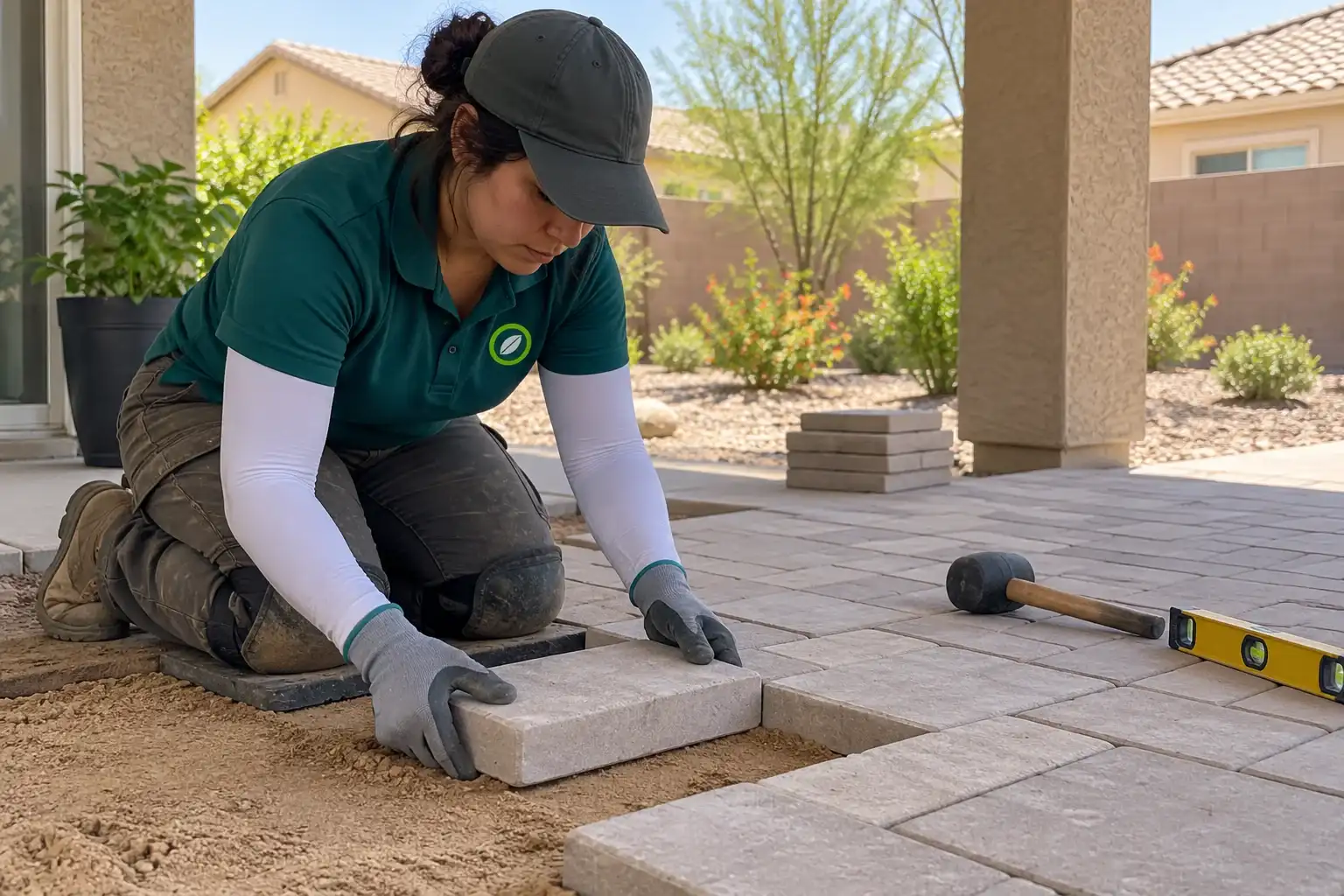
    Yes. Pavers handle heat better than poured concrete in one specific way: a cracked or settled section can be lifted and reset without replacing the whole slab. That matters on soil that moves with moisture.

    Paver patios average about $3,800 for 280 square feet, with a range of $480 to $22,500 and $8 to $50 per square foot depending on size, material and detail (national cost guide, 2026). Travertine tends to stay cooler underfoot than concrete, and a sand tone hides dust better than dark gray.

    The base is the job. Caliche and expansive soil both need excavation and a compacted gravel base, and the patio has to slope away from the house. A patio laid on 2 inches of sand can look fine in March and hold water against the wall by August.

    Published ranges, not a quote.

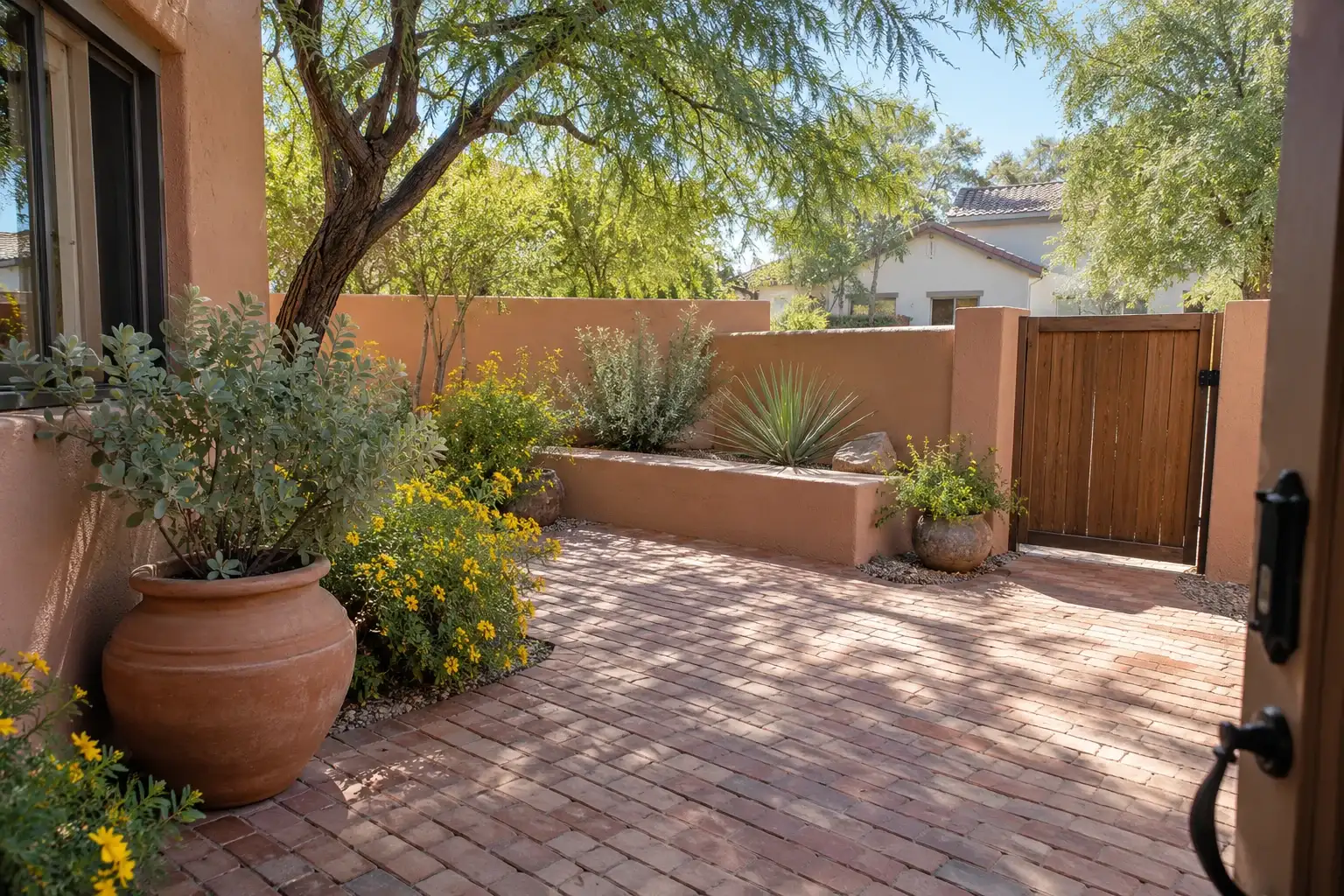
    Walled courtyard with a terracotta paver floor, a clay pot, desert shrubs and a wood gate
  7. 07 / 16

    Why do sprinkler systems fail here?

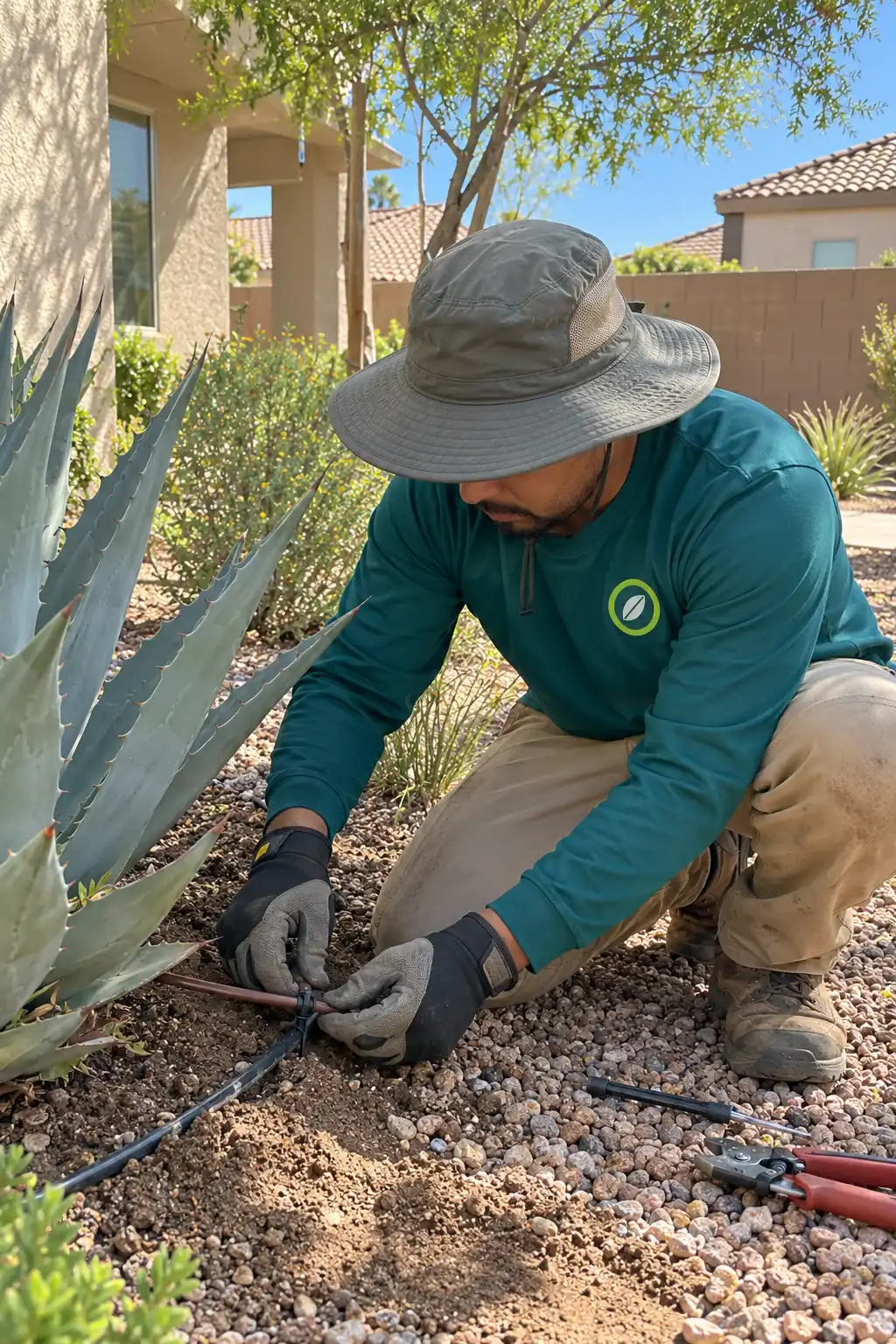
    Common failures come from 4 things: sun baked plastic, hard water, tree roots and pressure. A head that sits in full sun through July gets brittle, and the first mower or footstep cracks the riser. Chandler water leaves mineral scale in the small orifices, so a nozzle that threw a clean fan in March sprays a weak stream by August.

    Roots are the quiet one. A mesquite or ficus sends roots toward the moisture in a drip line, and a lateral that ran clean for years pinches shut or splits at a joint. Pressure spikes at night do the rest, especially on a system with no regulator.

    The symptom is usually a dry patch or a wet spot, not a part you can see. A zone that runs and does nothing, or a meter that spins with the controller off, narrows it down fast. Most repairs run $137 to $422, average $278, per a national cost guide, 2026, from 36,233 projects.

    Published ranges, not a quote.

09Published ranges

How much does it cost to landscape a backyard in Arizona?

  • Full backyard$15,000to$50,000National cost guide, 2026
  • Front yard$1,500to$5,000National cost guide, 2026
  • Most projects$1,248to$6,068National cost guide, 2026
  • Artificial turf$3,244to$8,714National cost guide, 2026

A full backyard renovation runs $15,000 to $50,000 nationally, and landscaping overall averages $3,516 with most projects between $1,248 and $6,068 (national cost guide, 2026, 32,752 projects). A front yard sits lower, at $1,500 to $5,000. Per square foot, budget $4.50 to $12.

What moves a Chandler backyard toward the top of that range: walls, a ramada, a full paver patio, turf over a large area, and grading for drainage. What keeps it low: keep the existing trees, replace lawn with gravel and low water plants, and stage the work over 2 seasons.

A backyard is 3 budgets in one: softscape, hardscape and irrigation. Pricing them separately shows what each part costs, because irrigation can sit inside a planting number or apart from it.

These are published national ranges, not a quote. The final price comes after someone sees the yard.

  1. 08 / 16

    Is $100 an hour too much for landscape work?

    $100 an hour is the top of the published band for a 2 person crew, which runs $50 to $100 per hour, per a national cost guide, 2026. So it is not out of line. What matters is what the hour includes.

    An hourly rate that covers 2 workers, their equipment and haul off is a different number from a rate that covers one person with a wheelbarrow. Crew size, the truck, disposal and any minimum visit charge can sit inside the rate or on top of it, and they explain why 2 hourly rates can differ.

    Hourly work suits small jobs: a bed cleanup, a few plants swapped out, a valve replaced. Larger builds price better as a fixed number, because the hours depend on soil nobody has seen until the shovel goes in.

    Published ranges, not a quote.

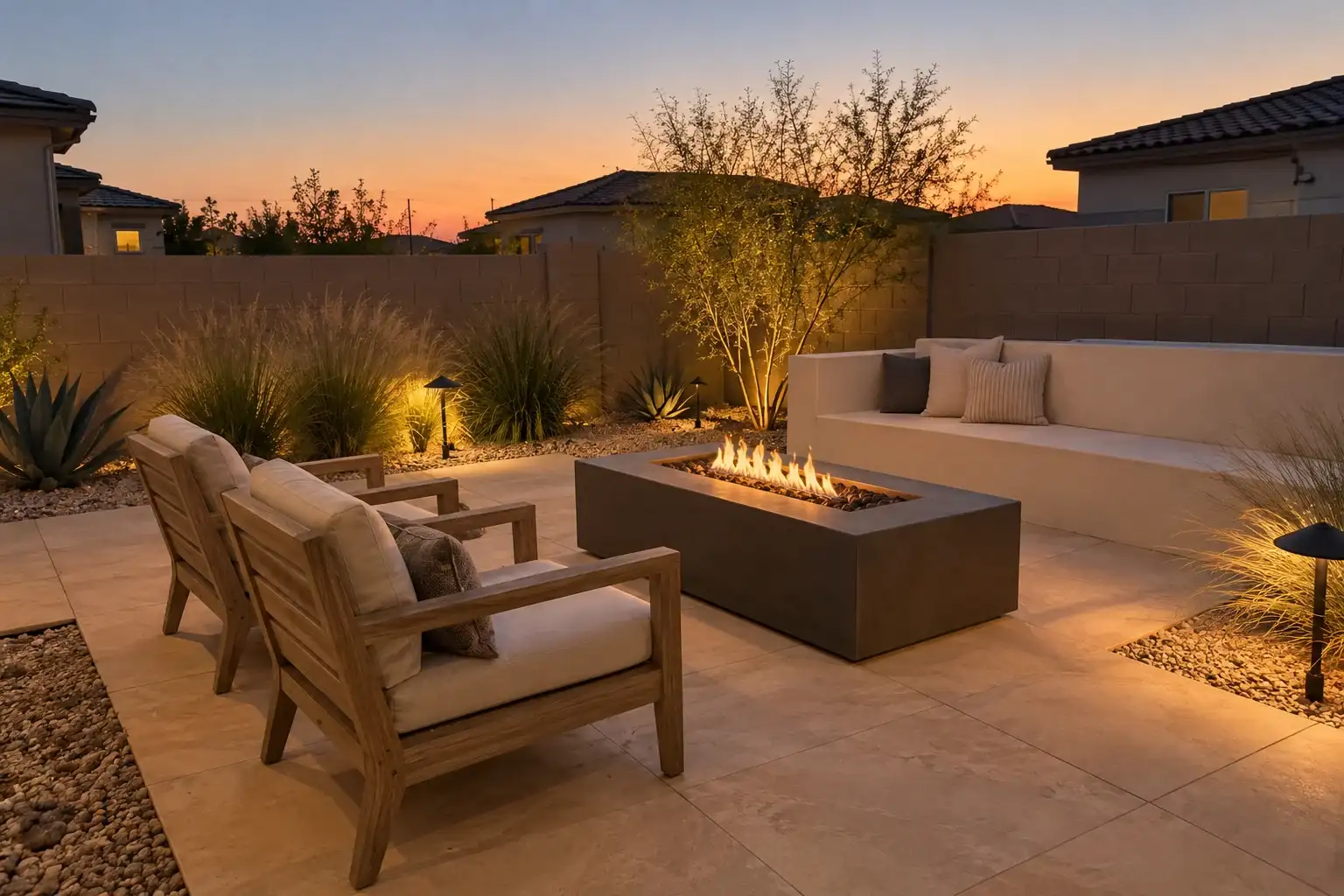
    Stone patio at dusk with a rectangular fire table, two lounge chairs and lit desert grasses along the wall
  2. 09 / 16

    How much for 2 hours of yard work?

    At the published crew rate of $50 to $100 per hour for 2 people, 2 hours of labor runs $100 to $200, based on a national cost guide, 2026. That buys half a morning from a small crew, not a project.

    A 2 hour visit covers a bed cleanup, trimming, weeding, resetting a few heads, or hauling one load of debris. It does not cover planting a tree, rebuilding a valve box, or laying turf, because those jobs are measured in days and in material.

    Green waste disposal, a minimum charge and travel time are 3 items that can raise the invoice above the labor number. A written scope before work starts settles what the 2 hours cover.

    Published ranges, not a quote.

  3. 10 / 16

    What are the Chandler watering rules?

    Chandler's water schedule (opens in a new tab) asks for established grass watered no more than 2 to 3 times each week, most plants once a week, and cycle and soak settings so water sinks in instead of running off. The schedule is a ceiling, not a target.

    Cycle and soak means the controller runs a zone in short bursts with a pause between them. On caliche and clay, one long run pushes most of the water past the root zone and toward the street. 3 short runs get water down where the roots are.

    New plantings need more than the mature schedule for their first seasons. After that the schedule above is the goal, and a drip system on its own valve from turf makes it possible, because grass and shrubs do not want the same number of minutes.

    The city publishes the current schedule, and it changes with the season.

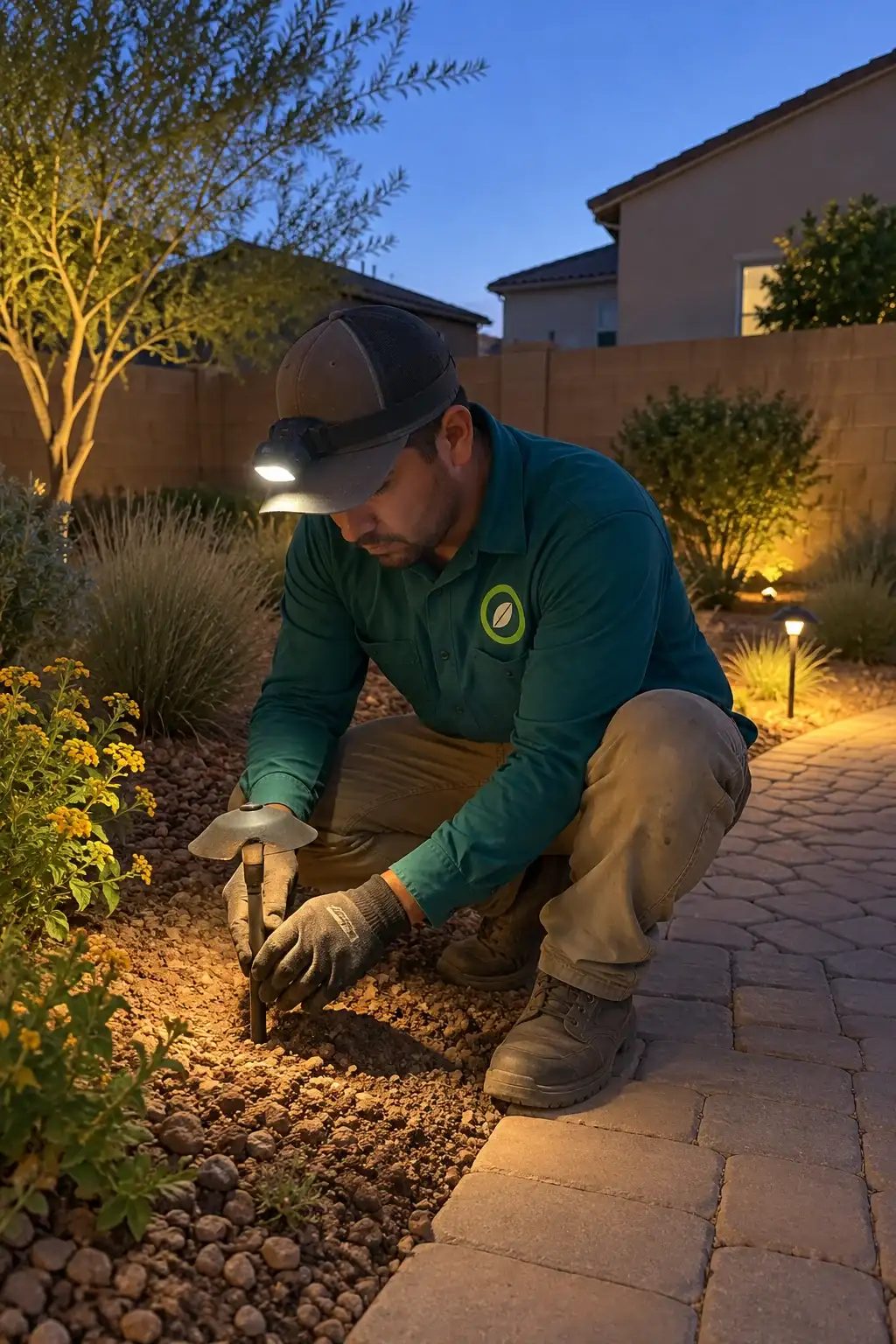
    Landscaper adjusting a path light beside a paver walk at blue hour
  4. 11 / 16

    Does Chandler pay a rebate for removing grass?

    Yes. The Grass to Xeriscape Rebate (opens in a new tab) pays $1.50 per square foot up to $2,000, for at least 500 square feet of grass removed. The order of operations is the part people get wrong.

    You need a Notice to Proceed from the city before any grass comes out. Remove the grass first and the rebate is gone, even if the new planting is perfect. Apply, get the notice, then schedule the work.

    The design has to show 50 percent ground coverage with low water plants at maturity, so a yard of gravel and 3 shrubs will not pass. The city reports the average conversion saves 75,000 gallons a year, which is the real return, since the rebate covers part of the install and the lower water use keeps paying back every month after.

    Plan the plant count before you apply.

  5. 12 / 16

    Can artificial turf be part of a rebated xeriscape conversion?

    No. Artificial turf is not eligible for the Chandler rebate, and neither is hardscape (City of Chandler (opens in a new tab)). The rebate is for living low water plants, not for a surface that looks planted.

    That does not stop you from putting turf in the yard. It means the turf area cannot be counted toward the square footage you claim, and it cannot be counted toward the 50 percent living coverage the design needs. Keep the 2 numbers apart on the drawing: turf here, rebated planting there.

    A common layout puts turf in one rectangle for dogs or kids, then plants the rest of the yard at the required density, with gravel or decomposed granite between them. The rebate applies to the planted portion. Turf runs $3,244 to $8,714 on most projects nationally, per a national cost guide, 2026, and comes out of your pocket.

    Published ranges, not a quote.

    Draw the line before you dig.

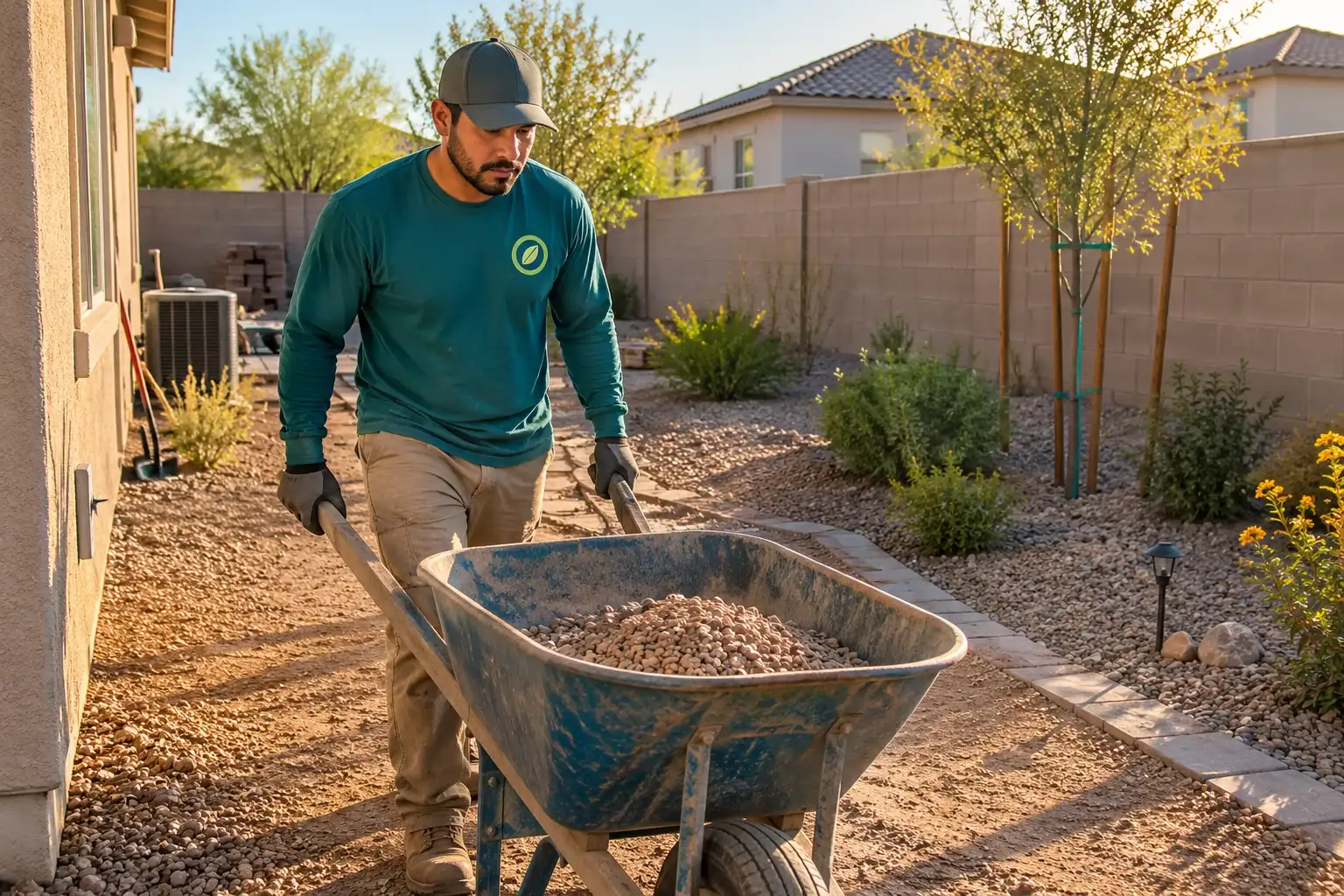
    Landscaper pushing a wheelbarrow of gravel along a side yard at golden hour
  6. 13 / 16

    What planting zone is Chandler in?

    Chandler sits in USDA hardiness zone 9b, with an average annual extreme minimum of 25 to 30 F on the 2023 USDA hardiness map (opens in a new tab). That number is the coldest a normal winter is likely to get, and it sets which plants survive here long term.

    Zone 9b is warm enough for most desert trees and shrubs and cold enough that tropical plants are a gamble. A few nights near 25 F can burn a bougainvillea back to the ground while a mature palo verde comes through. That is the test a plant list has to pass.

    The zone number does not tell you about summer. A plant can survive 25 F in January and still cook in June if it faces west with reflected heat from a wall. Use the zone for cold, use sun exposure for placement, and check both before you buy.

    The map is a starting point, not a plant list.

  7. 14 / 16

    Which plants handle Chandler heat and still look good?

    Trees first: palo verde, mesquite and desert willow all take full sun and reflected heat, and they give the shade that makes the rest of the yard possible. A tree on the west side can do more for a summer power bill than any shrub choice.

    For structure, use agave, aloe and desert spoon as accents rather than fill. For color across a long season, lantana, oleander and bougainvillea are hard to kill, though the last 2 want room and a wall to lean on. Ornamental grasses and trailing rosemary fill the gaps between them on little water.

    The planting pattern that works here is sparse at maturity and full at install. Plants spaced for their adult size look empty in year 1, so fill the gaps with fast annuals you remove later. Crowding a bed to make it look finished on day one is a common mistake, and it shows in year 3 when everything fights for the same emitter.

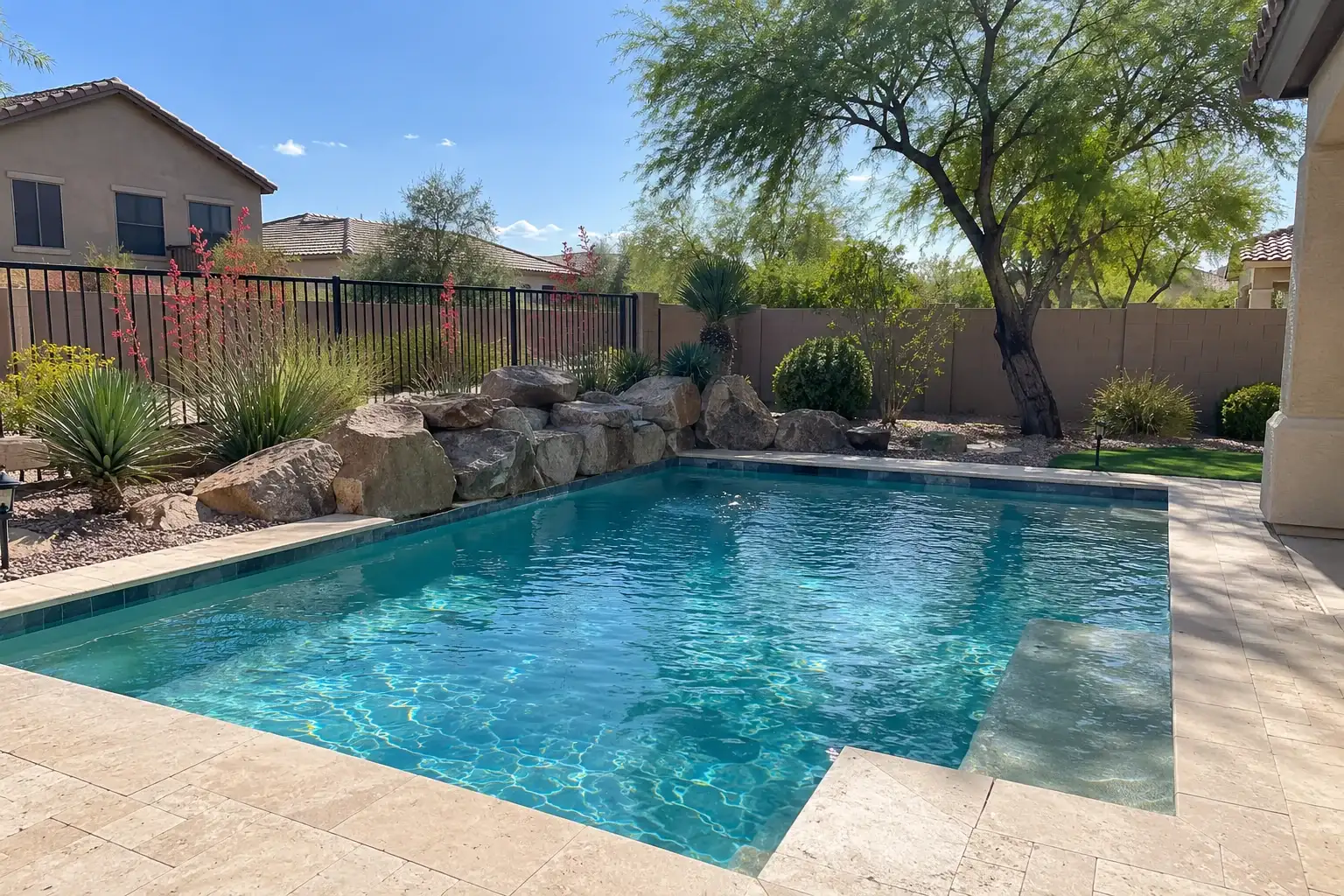
    Backyard pool with a travertine deck, boulders and desert planting along an iron fence
  8. 15 / 16

    What is caliche and why does it matter?

    Caliche is a cemented layer of calcium carbonate in the soil. It builds up over time as calcium carried in by rainwater turns into calcium carbonate, and a layer can run from a few inches to several feet thick (University of Arizona Cooperative Extension (opens in a new tab)). It can behave more like weak concrete than like dirt.

    2 things go wrong because of it. Water cannot drain through, so a planting hole becomes a bucket that holds water against the roots. And roots struggle to push through, so a tree planted into a shallow hole can stay small and then lean after a wind storm.

    The fix is mechanical: dig completely through the layer so water can drain, break it up, and grade so water has somewhere to go. A bar and a shovel handle small beds. Larger areas need a machine.

    Plan for it before the first hole is dug.

  9. 16 / 16

    What happens to a Chandler yard in monsoon season?

    Monsoon rain arrives fast and leaves fast. Heavy rain can fall in under an hour on ground that has baked for weeks, and the water has to go somewhere. On a yard with no grade plan, it goes against the house or into the neighbor's lot.

    3 things fail in that kind of storm: drainage that runs toward the house, berms that trap water in a bed, and drip lines buried shallow enough to wash out. A wall with no weep path holds water behind it until the weight wins.

    The fix is designed in, not added later: slope the patio and the soil away from the walls, keep a path for water across the lot, and put gravel or a dry channel where the flow concentrates. Walk the yard after the first storm of the season and you will see exactly where the water wants to go.

    Then plant there, or channel it. Do not fight it.

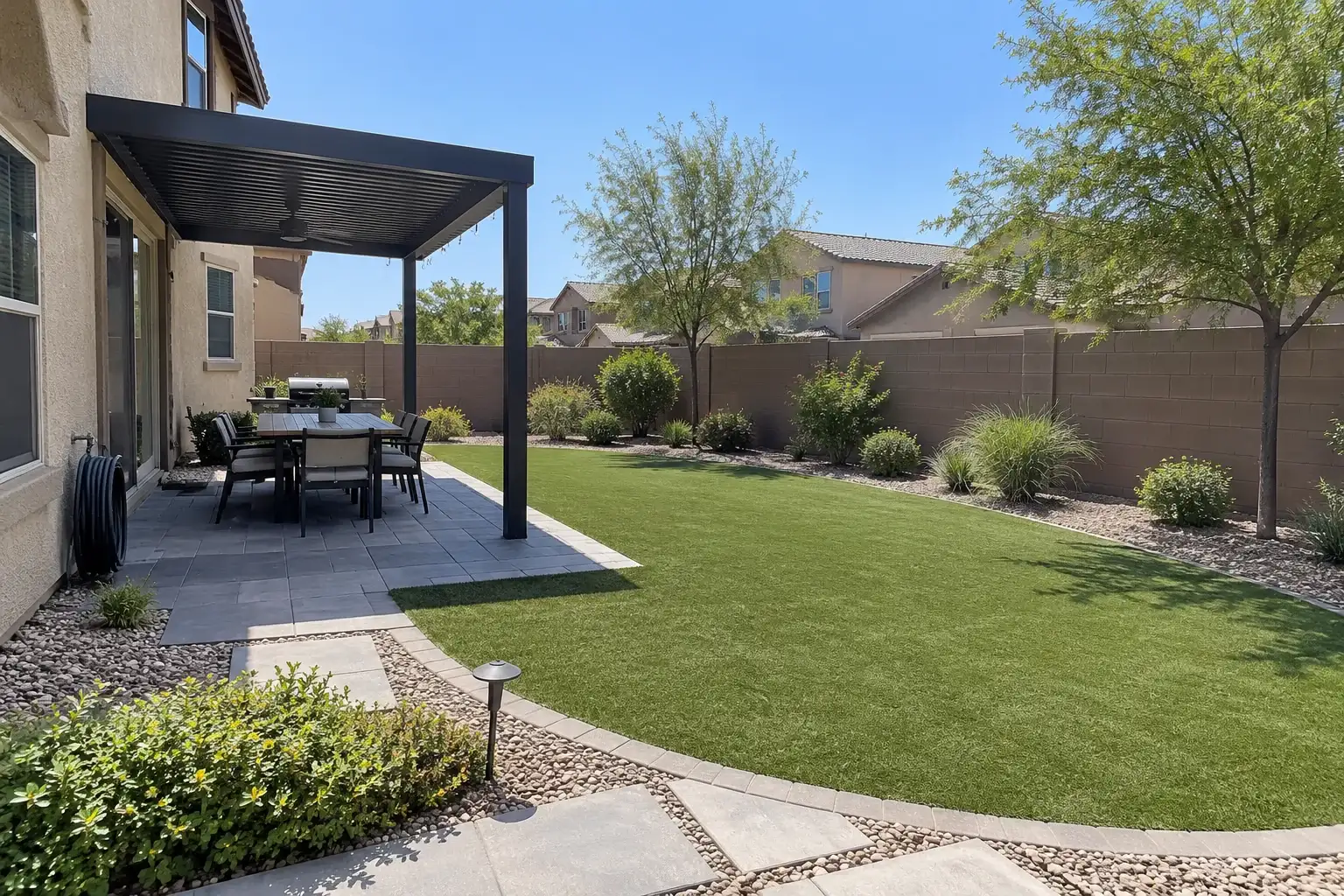
    Family backyard with a curved artificial turf lawn, a paver walk and a dark metal pergola over a dining table

193 steps

How does the process work from first call to finished yard?

  1. Call or send the form

    It starts with a call to (747) 243-2089 or the form on the contact page. You describe the project, the ZIP code and the rough size, and someone from our team will call you back to talk through scope, the published ranges and what a site visit would need to answer.

  2. Site visit and scope

    The site visit is where the plan gets real: measure the lot, check the soil, look at the irrigation and the grade, and note anything the HOA will ask about. From there a written scope with a price follows, split into softscape, hardscape and irrigation.

  3. The order of work

    Then the order of work: permits or HOA approval if needed, demolition and haul off, grade, irrigation, hardscape, planting, turf, mulch, and a walk through every zone with the controller set. Staging is normal. Many yards get irrigation and plants first and the patio a season later.

20Service area

Which areas around Chandler do you cover?

We serve Chandler and the towns around it. East of Chandler is Gilbert, which runs its own water department, so the schedule there is not the Chandler schedule. North are Tempe and Mesa, both with many older neighborhoods and smaller lots.

West of Chandler, on the south side of South Mountain, is Ahwatukee, where hillside lots can bring slope drainage into a patio plan. South and southeast are Sun Lakes and Queen Creek, one an age restricted community that wants shade and low upkeep, the other newer growth with larger lots and bare backyards.

Inside Chandler, the area pages cover Ocotillo, West Chandler and Downtown Chandler.

Further out are San Tan Valley, Maricopa and Apache Junction. Send the ZIP code with the request, and the call covers whether the job is in range.

Open in Google Maps (opens in a new tab)

217 questions

Questions people ask

Still have a question? Call (747) 243-2089 and describe the yard.

01

Is there a charge for the first visit?

It depends on the job, so ask on the callback. A repair or a small planting bed can often be scoped from photos, measurements and the ZIP code. A full yard with walls, grade changes and turf needs someone on site before any number is real. The visit is where soil and drainage get checked.

02

How long does a yard project take?

A single repair is a short visit. A full yard with demolition, irrigation, walls, turf and planting runs across several weeks, and weather and inspection schedules move that. The sequence matters more than a calendar date: grade and irrigation before hardscape, hardscape before planting, planting before mulch. That order is set out up front.

03

Do I need a permit from the city?

Sometimes. Planting and drip work generally do not need one. Walls, structures, gas lines and electrical work often do, and the city sets the trigger. Ask before work starts and get the answer from the city. A permit costs less than removing a wall.

04

What is the best month to landscape in Chandler?

Fall and spring are easier on new plants, because roots establish while the air is mild. Summer installs are possible, but new plants need more water and more shade for the first weeks. Winter is fine for hardscape and grading. If a rebate is involved, the Notice to Proceed sets the start date, not the weather.

05

Can I keep some of my existing plants?

Yes, and often you should. A mature tree is worth more than anything a nursery can sell you, and it already has roots down past the caliche. The plan flags what stays, what moves and what comes out, then works around the keepers. The exception is a plant that is failing or planted too close to the house.

06

How much water does a new xeriscape need?

More than a mature one, for the first year or 2. New plants have small root balls and the emitters have to keep up with summer. Once established, most plants drop to once a week on the city schedule. Use cycle and soak so water reaches the roots instead of running off the surface.

07

What if my yard is almost all caliche?

Then the planting holes and the drainage both need mechanical work. Caliche is broken up with a machine or a bar. Beds get dug through the layer, and low spots get a path for water. It adds labor to the job and it is not optional, because a plant in a shallow hole over caliche may not last a summer.

Talk about your yard(747) 243-2089Send a request

Before you go: want a call back?

Leave your name, phone number, ZIP code and the service you need, and someone will call you back about your yard.

Call (747) 243-2089

Thank you. You will be called back soon.